Simply Success Newsroom
Week One introduced the contenders. Week Two introduced the chaos.
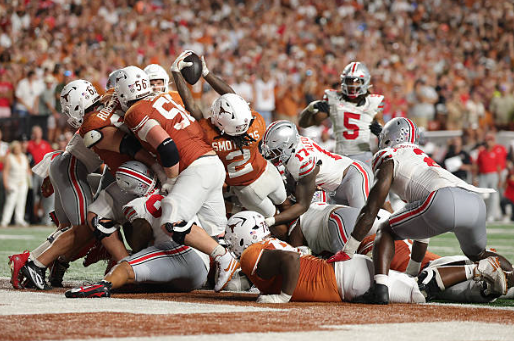
AUSTIN, TEXAS - SEPTEMBER 12: Hollywood Smothers #2 of the Texas Longhorns scores a touchdown against the Ohio State Buckeyes during the fourth quarter at Darrell K Royal-Texas Memorial Stadium on September 12, 2026 in Austin, Texas. (Photo by Alex Slitz/Getty Images)
College football has a way of reminding everyone that rankings are temporary, reputations are fragile and a game can change the national conversation in a matter of minutes.
That lesson arrived loudly on Saturday.
Texas entered its matchup with Ohio State as the No. 4 team in the country. Ohio State entered as No. 1.
By the end of the night, the college football hierarchy had changed.
Texas erased a 20 point fourth quarter deficit and defeated Ohio State 24 to 23, producing one of the most dramatic comebacks of the early season. And that was only part of the story.
Texas Just Changed Its Ceiling
There are wins, and then there are wins that change how a team is perceived.
This was the second kind.
Texas did not simply beat Ohio State. The Longhorns demonstrated that they could absorb a devastating start, make adjustments and execute when the pressure was at its highest. Quarterback Arch Manning became part of that conversation as Texas rallied in the fourth quarter. The Longhorns scored 21 unanswered points after entering the final period down 23 to 3.
That type of resilience matters because championship football is rarely perfect.
Teams will fall behind. Star players will struggle. Game plans will fail. The question is what happens next. Texas answered that question.
Oregon Learned the Other Side of the Equation
If Texas represented resilience, Oklahoma State represented opportunity.
The Cowboys shocked No. 6 Oregon 39 to 31, snapping a 12 game losing streak and ending a 21 game losing streak against FBS opponents. Quarterback Drew Mestemaker threw for 317 yards and two touchdowns while adding 109 rushing yards.
That result is significant beyond the upset itself.
College football has become increasingly difficult to predict because the talent ecosystem has changed.
Transfer opportunities, NIL resources, coaching movement and expanded access to development have created more pathways for programs to close the gap.
A team that looks overmatched on paper can be considerably different on Saturday afternoon.
Oregon discovered that firsthand.
Michigan Reentered the Conversation
Michigan also delivered a response after the turbulence of opening week.
The Wolverines defeated previously No. 11 Oklahoma 17 to 10, helping restore some confidence after their narrow Week One victory over Western Michigan.
The result also moved Michigan back into the AP Top 25 at No. 19, while Oklahoma dropped to No. 24.
That is an important lesson about college football.
The story is rarely finished after one Saturday. Programs have opportunities to respond. Players have opportunities to redefine narratives. Coaches have opportunities to correct mistakes.
The Rankings Now Tell a Different Story
Following Week Two, Texas moved to No. 1 in the AP Top 25, receiving 56 of 68 first place votes.
Ohio State dropped to No. 6.
Oregon fell to No. 21.
Michigan returned at No. 19.
Meanwhile, Georgia and Notre Dame remained near the top, and Miami moved into the top five.
The movement illustrates why early season rankings should be viewed as a snapshot rather than a prediction.
The most interesting part of the rankings is not necessarily who moved up or down. It is why.
Teams are now being evaluated on their ability to respond to adversity, not simply their preseason reputation.
The NIL and Athlete Branding Angle
There is another story underneath all of this.
For athletes, these games are career accelerators. A nationally televised performance against a top ranked opponent can change how an athlete is viewed by fans, scouts, brands, media outlets and professional organizations. That makes personal branding increasingly important.
The athlete's football résumé matters. But so does the athlete's ability to communicate, connect with an audience, represent brands professionally and create a story that extends beyond the scoreboard.
Week Two showed us that the college football brand can change overnight.
So can an athlete's.
Simply Success Sports Newsroom Perspective
Week Two did not simply produce winners and losers.
It created new questions.
Can Texas remain at the top?
Can Ohio State recover?
Was Oklahoma State's victory an upset or a sign of a changing competitive landscape?
Can Michigan build momentum?
And which emerging players will turn early season visibility into something bigger? Those questions are what make college football compelling.
The season is no longer about proving who was supposed to be good. It is about discovering who actually is.
Photo Credit: Getty Images